
What Changes
An Open Arena Is a Fence. A Covered One Is a Building.
An open arena asks very little of timber. Rails, kickboards, gate posts and corner posts, all of it short, none of it carrying much beyond itself. People price one and assume a covered arena is the same job with a roof added to the quote.
It is not the same job. The moment there is a roof, the structure has to carry its own weight plus whatever lands on it, across a span with nothing underneath, through columns that take the whole load into the ground, while resisting wind trying to lift the roof off. That is a building, and in most jurisdictions it is a permitted, engineered one.
For a mill the practical consequence is that the order changes shape entirely. Instead of a long list of small repetitive members, a covered arena is a short list of large ones, in long lengths, where the sizes have been set by an engineer and are not negotiable. That is the order we are built for, and it is also the order most suppliers quietly cannot fill.
Height
Clearance Is Set by What You Ride, Not by the Building
Eave height and the clearance at the center of the span are discipline decisions before they are structural ones. Flatwork and dressage need less overhead than jumping, and jumping needs considerably less than reining or anything involving a rider standing in the irons under the lowest point of a truss.
This matters to the timber order because height compounds. Taller columns are longer members, which may cross a length surcharge tier. They also attract more wind load, which can push their section size up, which pushes the board footage up again. A decision that feels like it is about comfort turns into a line item.
The advice we give is to settle the discipline and the clearance before the engineer starts, rather than asking for more height after sizing is done. Changing it late is one of the few revisions that reliably forces the whole frame to be recalculated.
The Other Option
Timber Against a Steel Building
Most people pricing a covered arena also price a steel package, and they should. We sell timber, so take the comparison with that in mind. Steel genuinely wins on some of this.
| Consideration | Heavy Timber | Steel |
|---|---|---|
| Condensation | Does not drip on the footing in the way a bare metal roof does | Needs insulation or a vapor control layer to stop it raining indoors |
| Noise in weather | Rain and wind are noticeably quieter overhead | Loud enough in hard rain to unsettle some horses |
| Very long spans | Practical to around the width of a standard arena | Goes further before cost climbs steeply |
| Contact with a horse | Forgiving. Scuffs rather than dents or cuts | Unforgiving, and sharp once damaged |
| Appearance | The reason most owners choose it | Industrial unless it is lined out |
| Repair in 20 years | A member can be replaced in place | Usually a specialist job |
The condensation line is the one worth dwelling on, because it is the one people discover after the building is up. A cold metal roof over a warm humid arena full of horses collects moisture on its underside and drops it onto the footing. Wood does not behave that way, which is why steel arena packages so often come with an insulation or liner cost that was not in the first quote you compared.
At genuinely large spans steel pulls ahead and we will say so. If your arena is wider than a standard riding footprint, steel is probably the right answer and we would rather tell you that than sell you a difficult timber frame.
Our Part
What We Cut for a Covered Arena
Columns, truss members, purlins, beams, braces and headers, in Coast Douglas Fir, No. 1 Structural as standard and Select Structural where it earns the upgrade. Sections from 6x6 through 30x30, lengths to 60 ft.
The 60 ft figure is the one that matters most on this job. Most suppliers stop at 20 ft, which means splicing members over the span and detailing every joint. Fewer splices is a stronger frame, a faster raise and less hardware, and the length surcharge often costs less than the connections it replaces.
Free of Heart Center is available to 12x12. On a covered arena the columns are what people stand next to, so that is usually where it is worth spending. Above 12x12 it cannot be cut, which is a log constraint rather than a policy.
Order It as a Kit
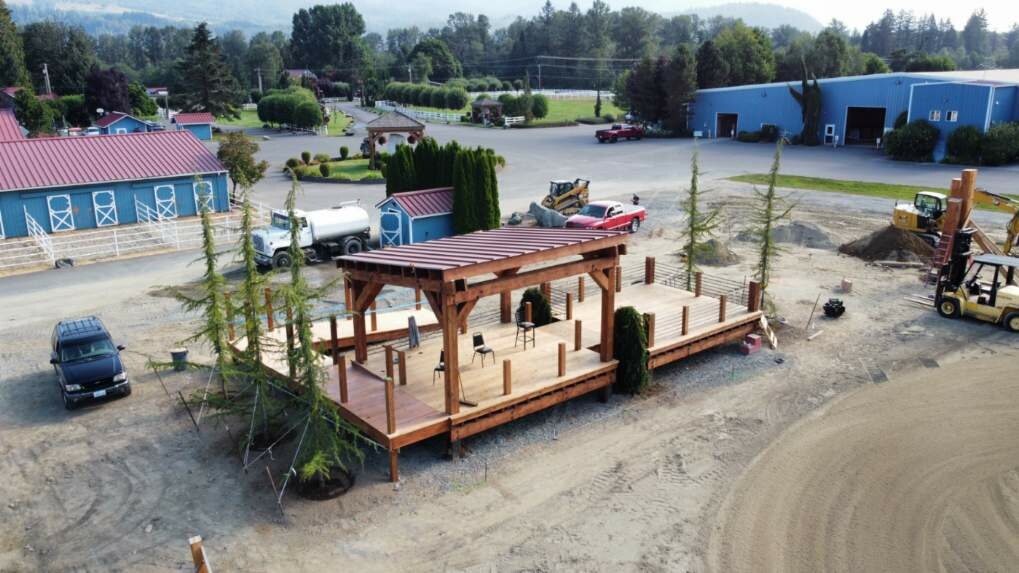
A covered arena is one of the clearest cases for a build kit rather than raw sections. Members arrive cut to length and prepared with the hardware, which matters when the crew raising a 70 ft truss is a general contractor rather than a timber framing outfit. Construction itself goes to your builder, or to Svensen Builders in Western Washington.
Next
Work Out What the Timber Costs
Timber is a defined share of a covered arena and it is the share we can price exactly. If you want to understand where the number comes from before you send drawings, there is a full worked example on what arena timber costs, including how the volume break and the length tiers interact. Sizes and design values are on the specifications page.
What Arena Timber Costs