Inside Our Arlington Mill: How We Cut Oversized Douglas Fir
Washington Timber Company has milled Douglas Fir in Arlington, WA since 1977. A look at how we operate, what we cut, and why oversized timber is our specialty.
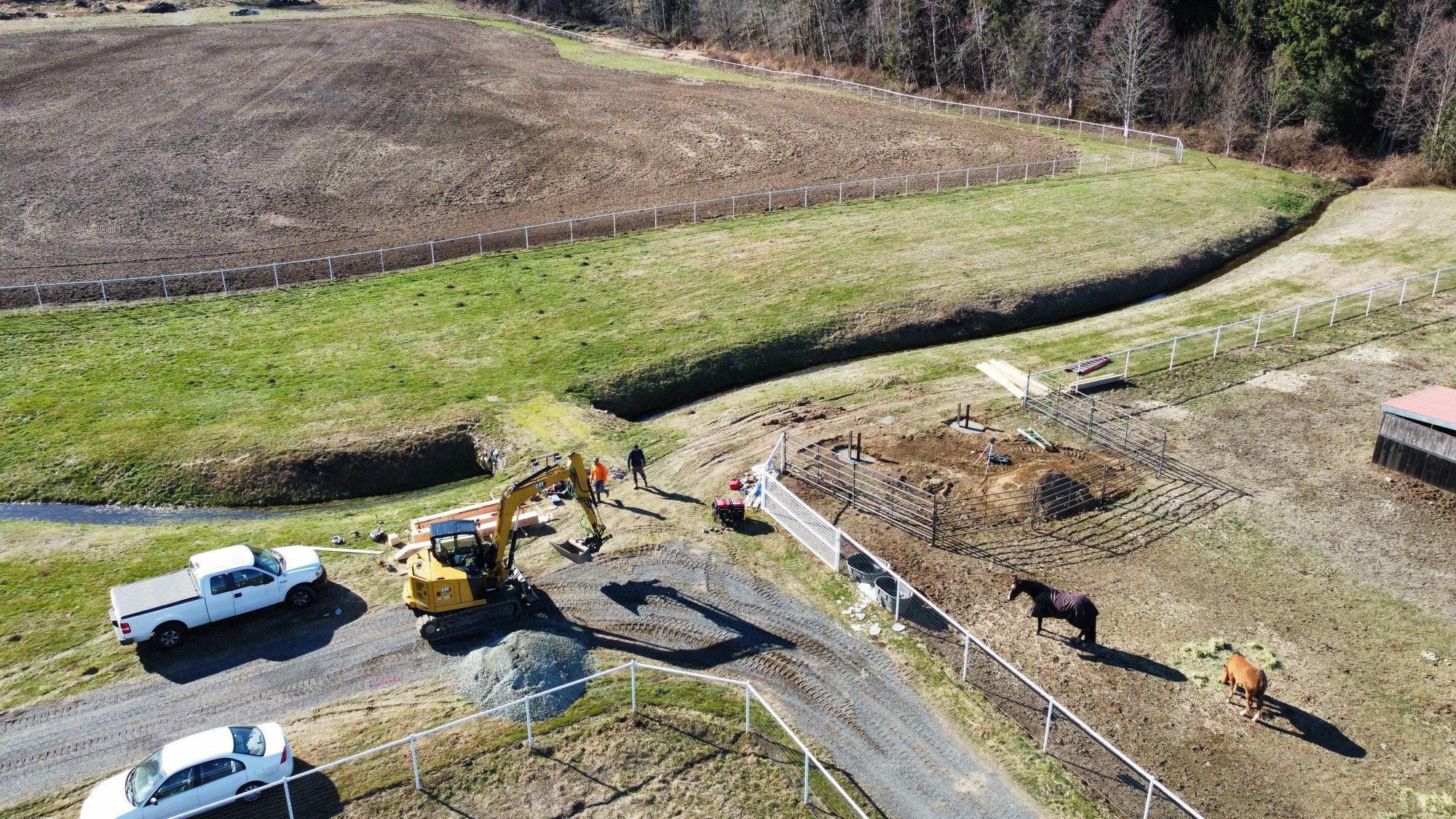
Our mill sits on Deer Creek at the North Fork of the Stillaguamish River, on a property that has been a working timber operation since 1977. From here we mill Douglas Fir for projects across the Pacific Northwest, throughout the United States, and internationally.
If you have ever wondered what actually happens between a standing tree and a finished structural timber, this is a look inside the operation.
The Arlington Location
Arlington, Washington sits at the foot of the North Cascades, about 45 minutes north of Seattle. The location is not accidental. We are in the heart of Douglas Fir country. The forests of the Stillaguamish and Skagit valleys have been producing structural timber for over a century, and the infrastructure for moving logs and finished lumber is well developed.
Our property runs along Deer Creek, with the North Fork Stillaguamish nearby. The setting matters less than the logistics. Highway access for log trucks coming in, truck routes for finished timber going out. Power for the mill equipment. Water for fire suppression and dust control. Space to store logs, store finished timber, and operate three industrial bandsaws.
What Comes In
Logs arrive at the mill from regional timber operations. Most of what we cut is second growth Douglas Fir, harvested from managed forests on a sustainable rotation. We also handle old growth when projects call for it, sourced from legally available stands.
Each log is evaluated when it arrives. We look at:
- Diameter and length. What dimensions can be cut from this log?
- Quality. Knots, sweep or curvature, shake meaning internal cracks, and other defects.
- Heart center position. For FOH cutting, where is the heart and how do we cut around it?
- Grain orientation. What is the grain pattern and how should it run in the finished timber?
- Best yield. What combination of cuts produces the most value from this log?
A good log evaluation can mean the difference between getting two structural beams or three from the same log. After decades of doing this, our team reads logs efficiently.
The Mill Equipment
We operate three industrial bandsaws, each suited to different work:
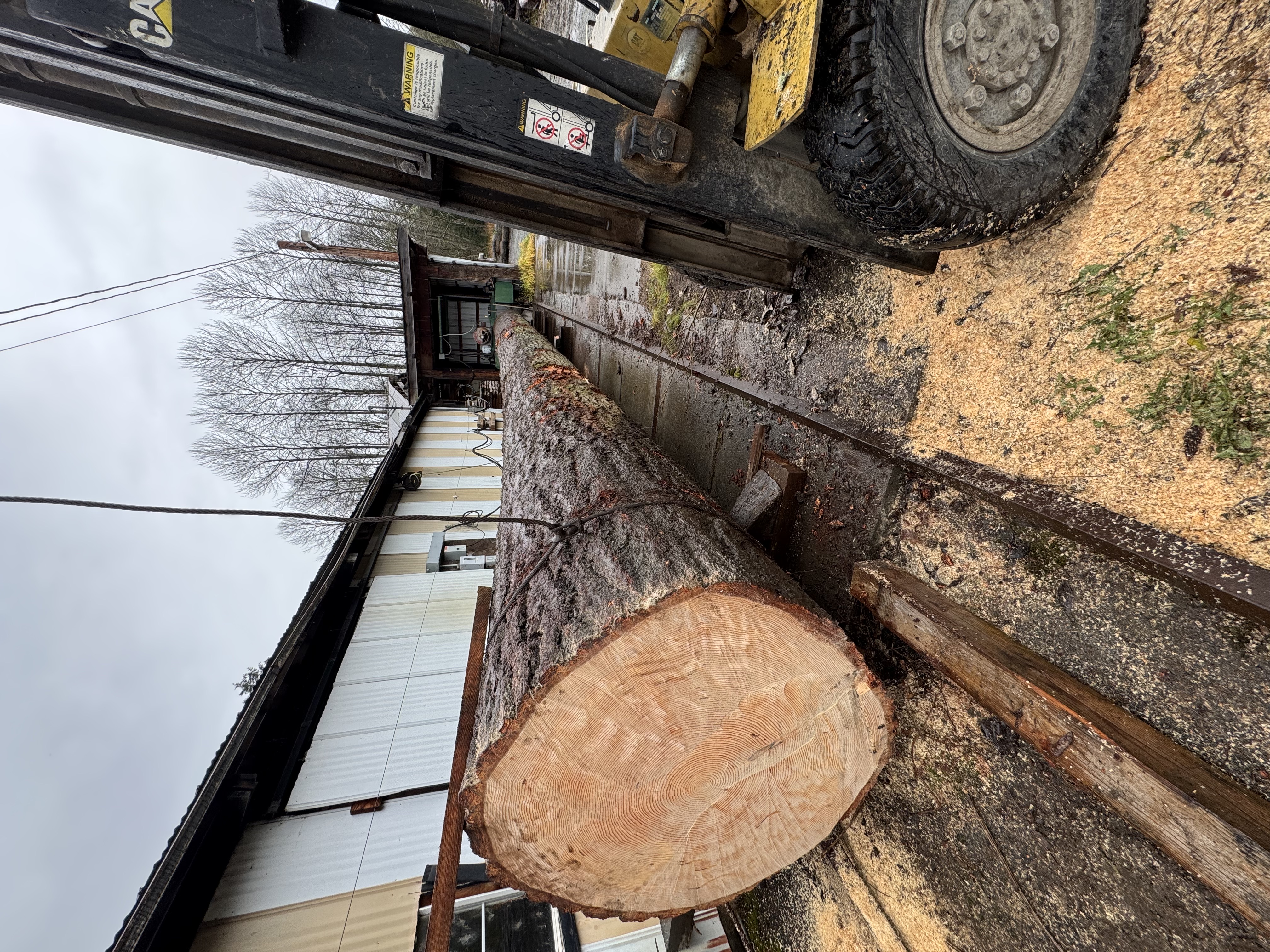
The large primary bandsaw. Handles the biggest logs we get, up to 4 feet in diameter and 60 feet long. This is where oversized work happens. Cutting a 30x30 or a 24x30 timber starts with this saw breaking down a very large log.
The mid size bandsaw. Handles standard heavy timber work, 12x12 through 20x20 sizes from logs in the 30 to 48 inch diameter range. Most of our production runs through this saw.
The smaller resaw. Used for cutting larger cants down into multiple smaller pieces, secondary cuts, and trim work.
We can sharpen and tune the saws on site. Saw maintenance is constant. A dull or improperly tensioned blade gives poor cuts and wastes wood. Our saw filers have decades of combined experience keeping the blades sharp and true.
The Cutting Process
A typical big timber order goes through these stages:
Log selection. From our yard inventory or from incoming deliveries, we pick logs suited to the order. A 24 foot 16x16 needs a different log than a 12 foot 8x8.
First breakdown. The log goes through the primary saw. The sawyer makes the initial cuts that determine the major dimensions of what comes out.
Sizing cuts. Subsequent passes through the saw bring the timber to final dimensions. For a 16x16, this is typically 4 to 6 passes depending on the starting log shape.
Grading. A WCLIB qualified grader evaluates each finished timber. The grade stamp goes on each piece identifying the grade, species, and mill.
Sorting. Timbers go to assigned stacks based on the order they belong to. For large orders, we keep all the pieces together throughout production.
Drying. Most heavy timber goes through air drying. The pieces sit stacked with stickers, meaning spacing slats, between layers, exposed to air flow. Larger sizes of 16x16 and up can take 6 to 12 months to reach equilibrium moisture content. Smaller timbers dry faster. This is drying time, not order lead time. Material we ship on a normal order comes from stock that has already been through this. If you are wondering why we air dry rather than run these through a kiln, we covered that separately in why large timbers are not kiln-dried.
Final inspection. Before shipping, each timber gets a final check. Any pieces that developed issues during drying, such as significant checking, twisting, or splits, get pulled and replaced. Not all movement is a defect — seasoning checks are permitted within grade. Twist, splits, and checks walks through where that line sits.
Loading and shipping. Finished timbers load onto flatbed trucks, or oversize loads with permits for the largest pieces, and ship to the customer.
What Makes Oversized Work Different
Most mills can cut standard sizes. The 6x6 through 12x12 range is well within the capability of any decent regional mill. What sets us apart is the ability to cut oversized work efficiently and reliably.
A few things that make oversized work harder:
Log sourcing. A 30x30 timber needs a log with at least 38 inches of clear diameter inside the bark. That is a big log. Sourcing these requires industry relationships and the ability to handle premium log prices.
Equipment capacity. The bandsaw, the carriage, and the material handling all need to accommodate the size. Many regional mills cannot physically run logs over a certain size through their equipment.
Sawing technique. Cutting a large timber from a large log requires skill. The cuts have to be planned to maximize yield, work around defects, and produce timbers that meet grade. An inexperienced sawyer cutting a $5,000 log can produce $2,000 worth of timber if they cut badly.
Drying patience. Large timbers take a long time to dry. You cannot rush it. We air dry our heavy timber for as long as it takes, sometimes a year or more for the biggest pieces.
Handling logistics. A 24x24 at 30 feet weighs over 5,000 pounds. Moving it around the mill yard, loading it onto trucks, and protecting it from damage requires the right equipment and experience.
What We Ship
In a typical year, our mill produces timber going to:
Residential timber frame homes. Throughout the Pacific Northwest and across the country. We are one of the regional suppliers timber framers reach to for material.
Equestrian arenas. From smaller barn projects to large commercial training facilities. Equestrian work has grown into a significant part of our business.
Commercial buildings. Restaurants, breweries, retail, and office spaces choosing heavy timber for the look and structural performance.
Bridges and infrastructure. Public works projects, private road bridges, and trail bridges. Bridge work often calls for our largest sizes.
Historic restoration. Matching original old growth members in restoration projects across the country.
International export. We ship to Asia and Europe regularly, particularly for high end timber framing projects abroad.
Build kits. Through our build kit program, prefabricated timber structures ship to customers nationally.
The Family and Crew
The mill is owned and operated by Shawn Roten, who has been in the timber business for four decades. Our team includes sawyers, graders, mill operators, and yard crew who handle everything from log evaluation to final shipping. Most of our team has been in the timber industry for years, and the institutional knowledge is what makes consistent quality possible.
We are a working operation. Our website, this blog, and our customer service exist to help customers find what they need, but the heart of the business is the actual milling work happening every day in Arlington.
How to Work with Us
If you have a timber project, the simplest path is to send us your specs and we will quote it. We respond to written quotes within one business day. Most orders ship in 2 to 4 weeks, and very large or complex orders are quoted with lead times appropriate to the work.
Visits to the mill are by appointment. We are a working yard with heavy equipment moving, so we ask that you arrange a time rather than dropping in.
Request a project quote, explore our services, or learn more about WTC.
We have been milling timber on the same property since 1977. We plan to keep doing it.
Last updated August 13, 2026