Why Large Timbers Are Not Kiln-Dried
The physics of drying wood, why kilns damage oversized timbers, and what seasoning in place actually looks like for Douglas Fir 10×10 and larger.
Technical Bulletin TB-01 · Douglas Fir structural timbers 10×10 and larger
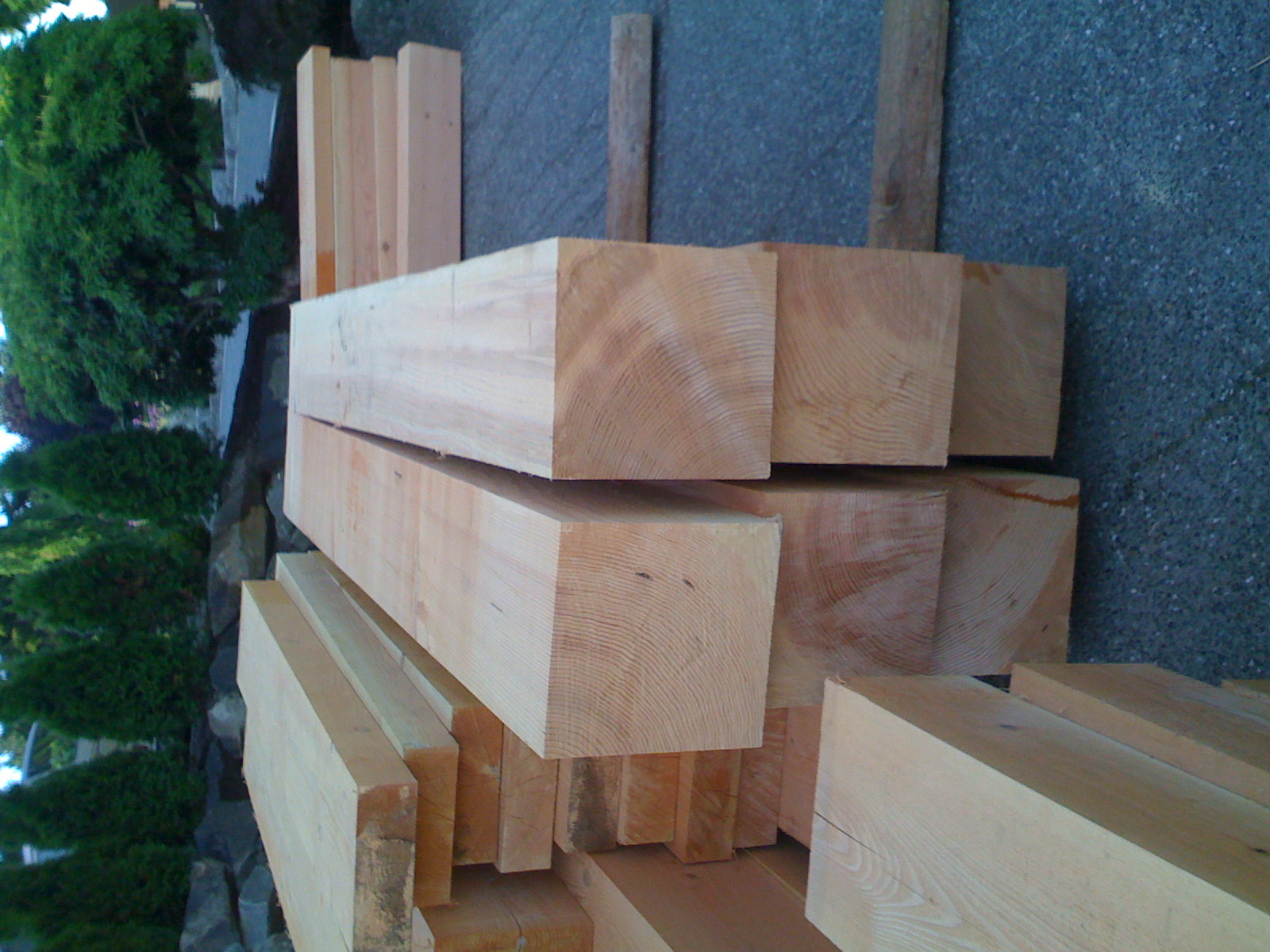
Sections 5 inches and thicker are graded, sold, and engineered green across the entire North American softwood industry. Timbers over 10×10 are almost never kiln-dried because the physics of drying wood makes it impractically slow, the process damages the timber more than it helps, and the grading rules and design values already assume the timber is green. Air seasoning in place is the standard — and the better result.
What the industry standard actually says
The question “are your timbers kiln-dried?” usually comes from buyers whose experience is with 2× framing lumber, where KD-19 (kiln-dried to 19% moisture content) is the norm. That norm stops at 4 inches nominal thickness. Above it, the rules change:
-
Grading rules. Under WWPA and WCLIB rules, the “Dry” (19% MC) designation applies only to lumber 4 inches and thinner. Timbers — Beams & Stringers and Posts & Timbers, 5×5 and larger — are graded and stamped as green (S-GRN) and are sized on that basis. Nothing in the grading system contemplates a kiln-dried 12×12; there is no stamp for one.
-
Design values. The National Design Specification for Wood Construction (NDS) publishes timber design values in Table 4D on the assumption that the member is green at installation and will season in service. That is why most wet-service adjustment factors (CM) for timbers are 1.0 — the values already account for it. An engineer using Table 4D is designing for a green timber whether or not they think about it.
-
Sizing. Rough-sawn green timbers are cut at full nominal dimension precisely because seasoning shrinkage is expected and modest. A green 12×12 is a full 12 inches; it will finish, in place, somewhat under that. This is understood and built into the standard.
-
Historic practice. Every heavy-timber warehouse, mill building, trestle, and barn built in the last 150 years was framed green. The timber-frame trade still cuts green today as a matter of preference: green timber is easier to cut, joins tighter as it shrinks onto the joinery, and checks less than kiln-dried stock.
The physics: why drying time explodes with thickness
Kiln drying works by evaporating water off the surface of the wood and letting moisture from the interior diffuse outward to replace it. That diffusion is the bottleneck, and it does not scale in a friendly way. As a rule of thumb, drying time increases with roughly the square of the thickness: doubling the thickness quadruples the time.
Real-world kiln schedules bear this out.
| Section | Thickness | Time to 19% MC in kiln | Practical status |
|---|---|---|---|
| 2× lumber | 1.5 in. | 3–7 days | Routine (KD-19 standard) |
| 4×4 | 3.5 in. | 3–5 weeks | Done on request; upper limit of “Dry” grading |
| 6×6 | 5.5 in. | 2–4 months, with high degrade | Rare; usually only surface-dried |
| 8×8 | 7.5 in. | 6–12 months | Not commercially done |
| 12×12 | 11.5–12 in. | Well over a year; core may never equalize | Not done |
| 14×14 and up | 14 in.+ | Multiple years | Not done |
Times are indicative for Douglas Fir at conventional low-temperature schedules. Sources: USDA Forest Products Laboratory, Dry Kiln Operator’s Manual and Wood Handbook, Ch. 13.
A kiln charge that ties up a chamber for a year to dry a few thousand board feet has no economic model behind it. A commercial dry kiln earns its keep on 5- to 10-day cycles of dimension lumber. No sawmill or drying operation in the Pacific Northwest runs oversized timbers through a conventional kiln as a product line, because the chamber would be worth more empty.
Why a kiln makes large timbers worse, not better
Even setting time and cost aside, forcing a large section to dry from the outside in produces a physically worse timber. Four mechanisms are involved, and all of them get more severe as the section gets bigger.
Surface checking and end splitting
Wood only begins to shrink once it drops below the fiber saturation point (about 28–30% MC). In a kiln, the shell of a 12×12 reaches that point and starts shrinking within days while the core is still fully saturated and will not move. The shell is stretched over a core that refuses to shrink with it, and it tears. The steeper the moisture gradient, the deeper and more numerous the checks. A conventional kiln creates the steepest possible gradient; slow air seasoning creates the gentlest one.
Casehardening
When the shell dries and sets under tension while the core is still swollen, the shell “freezes” in a stretched condition. As the core later dries and tries to shrink, it is now held out by the set shell, putting the core in tension and the shell in compression. The timber looks dry on a surface meter and is internally locked in stress. Kiln operators relieve this in dimension lumber with a conditioning steam cycle at the end of the run; in a 12×12 the stress cannot be relieved because the core has not dried in the first place.
Honeycomb (internal checking)
If drying is pushed hard enough to actually move the core, the casehardened shell holds the outside dimension while the interior shrinks away from it. The wood fails internally along the rays, producing hidden cavities that never show on the surface. Honeycombed timber can pass a surface moisture check and still be structurally compromised. This is the single most damaging drying defect and it is almost exclusively a large-section problem.
Surface-only drying and the false reading
The practical outcome of a short, affordable kiln run on an oversized timber is a member that is dry to a depth of an inch or two and green underneath. A pin meter reads 15% on the surface; a probe driven 3 inches in reads 40%. The buyer has paid for a kiln charge, received a timber with more checking than an air-dried one, and gained no real reduction in the in-service movement they were trying to avoid, because the core will still shrink in place.
A kiln-dried oversized timber is, in practice, a surface-dried timber with more checks, locked-in stress, and a risk of hidden internal failure. It is not a better product than the same timber seasoned in place.
What seasoning in place actually looks like
The concern behind the kiln question is movement: will the timber shrink, twist, or open up after installation? The honest answer is that it will season slowly over one to several years, and the movement is small. Douglas Fir shrinks on the order of 4–5% radially and 7–8% tangentially from green to oven-dry; in service it only dries to equilibrium (roughly 12–16% MC in Western Washington, lower in heated interiors), so the realized shrinkage is a fraction of that.
| Green section | Width / thickness change | Length change (20 ft) | Notes |
|---|---|---|---|
| 8×8 | about 1/8 to 1/4 in. | under 1/4 in. | Free of Heart Center available |
| 10×10 | about 3/16 to 5/16 in. | under 1/4 in. | Free of Heart Center available |
| 12×12 | about 1/4 to 3/8 in. | under 1/4 in. | Boxed heart; expect one dominant check |
| 14×14 | about 1/4 to 3/8 in. | under 1/4 in. | 1.5–2.5% across the section |
| 16×16 and up | about 3/8 to 1/2 in. | under 1/4 in. | Slow, multi-year seasoning |
Longitudinal shrinkage in straight-grained Douglas Fir is about 0.1–0.2% — effectively nil. Width and thickness figures assume drying from green to typical in-service equilibrium in the Pacific Northwest.
Checking will occur in any boxed-heart timber regardless of how it is dried; it is the section relieving its own drying stress and it does not reduce the design capacity of a beam or post in the vast majority of applications. Grading rules already limit check size within each grade. Where appearance is critical, the correct answers are Free of Heart Center stock, a relief kerf on a hidden face, or specifying the dominant check to face away from view — not a kiln.
The exceptions, and why they are exceptions
Two technologies can dry large sections through the full cross-section, and it is worth naming them so the answer is complete:
-
Radio-frequency vacuum (RFV) kilns heat the water inside the timber directly with RF energy under vacuum, drying from the core outward. They work. They are also rare (a handful of operators in North America), small in chamber size, slow for large sections, and expensive per board foot — commonly several dollars per board foot on top of the timber cost, with lead times of weeks to months. They are used for high-end timber-frame packages and specialty work, not structural supply.
-
Glued-laminated timber (glulam) sidesteps the problem entirely: the laminations are 1.5-inch boards, kiln-dried normally, then glued into the large section. That is why glulam is the industry’s actual answer to “I need a dry 12×24 beam.” It is a different product with a different appearance, cost, and connection behavior, and it is the right choice when a dry, dimensionally stable large section is a genuine design requirement.
Neither changes the general rule. If a specification calls for a “kiln-dried 12×12 solid-sawn timber,” the specifier is asking for something the market does not produce as a matter of course, and the specification should be corrected to one of: green solid-sawn (standard), FOHC green solid-sawn (appearance), RFV-dried (specialty, with the cost and lead time understood), or glulam (dry and stable by design).
How Washington Timber Company handles it
| Item | WTC practice |
|---|---|
| Condition at shipment | Rough-sawn, green, full nominal dimension. All sections 5×5 and larger. |
| Grading | Graded green to WWPA / WCLIB rules; No. 1 standard, Select Structural on request. |
| Appearance control | Free of Heart Center available at 12×12 and 10×14 and smaller. Larger sections are boxed heart by nature of the log. |
| Kiln drying | Not offered on oversized sections, for the reasons above. We would rather explain why than sell a process that produces a worse timber. |
| Moisture questions | The person who answers the phone runs the mill and can tell you what a given section will do in your application. |
References: USDA Forest Service, Forest Products Laboratory, Wood Handbook: Wood as an Engineering Material (FPL-GTR-282), Chapters 4 and 13; USDA FPL, Dry Kiln Operator’s Manual (Agriculture Handbook 188); American Wood Council, National Design Specification for Wood Construction, Supplement Table 4D; Western Wood Products Association and West Coast Lumber Inspection Bureau grading rules for Beams & Stringers and Posts & Timbers.