Solid-Sawn Coastal Douglas Fir: Twist, Splits, and Checks
Twist and splits are grading problems, not species traits. How No.1 grade prevents twist and why seasoning checks don't reduce design capacity.
Technical Bulletin TB-02 · A technical response to the question “Can we get good solid-sawn wood?”
Twist and splitting are not properties of Douglas Fir. They are properties of low-grade or ungraded timber — spiral grain, juvenile wood, and shake that a No. 1 Structural grade is specifically written to exclude. Checking is different. Checking is what a sound heavy timber does as it seasons, it is limited by grade, and it does not reduce the member’s design capacity. The difference between the two is the whole subject of this bulletin.
The concern, stated fairly
The engineer’s position, paraphrased: solid-sawn timber is almost impossible to source well; even Free of Heart Center stock ends up just off the pith or with tight-radius grain; and either way the wood twists and splits as it dries. The one good solid-sawn project he cites was one where the owner controlled the mill, and good Canadian timber has become impractical to source.
Every one of those observations is a real experience, and we take it seriously. What we want to show is that each is a sourcing and grading problem, not a species problem — and that the one project he describes as working is the exact model Washington Timber Company is built on: the supplier owns the mill, selects the log, and grades the timber.
Why timber twists — and why No. 1 timber does not
Twist is not random. It is a geometric consequence of the grain not running parallel to the length of the piece. Three causes account for essentially all of it:
-
Spiral grain. Fibers that wind around the trunk shrink at an angle to the axis of the timber, so as the piece dries it rotates. This is the dominant cause of twist and it is a grading defect, not a species trait. Coastal Douglas Fir is one of the straightest-grained commercial softwoods in North America.
-
Juvenile wood. The first 10–20 growth rings around the pith have higher longitudinal shrinkage and lower stiffness. A timber cut from a small, fast-grown log is mostly juvenile wood and moves unpredictably. A timber cut from the outer wood of a large, slow-grown coastal log has almost none.
-
Off-center or tight-radius sawing. When a supplier saws a 12×12 from a 14-inch log, the pith sits near one corner and the growth-ring curvature is severe across the section. Shrinkage is then very different from one face to the opposite face, and the timber cups, bows, or twists. That is a log-selection failure. It is what “FOHC” from a supplier without adequate logs looks like.
The West Coast Lumber Inspection Bureau and WWPA grading rules for Beams & Stringers and Posts & Timbers address all three directly. No. 1 Structural limits slope of grain to roughly 1 in 10 (Select Structural to about 1 in 14), restricts knot size and placement, and excludes the shake and heavy wane that accompany poorly centered sawing. A timber that would twist does not pass a No. 1 grade in the first place. That is not a marketing claim; it is what the grade stamp certifies.
What engineers have often experienced is No. 2 or ungraded timber sold as “FOHC.” The correct response is a supplier with large logs and a grader, not a different structural material.
Splits, shake, and checks are three different things
The word “split” gets used for three defects with different causes and very different structural meaning. Grading rules treat them separately, and so should a specification.
| Defect | What it is | Cause | Structural effect | No. 1 grade |
|---|---|---|---|---|
| Split | A separation running completely through the timber from one face to another, usually at an end | Rough handling, end impact, or drying stress in a piece with shake or severe slope of grain | Reduces shear capacity at the end; a real defect | Length limited to a fraction of the width; a through-split disqualifies |
| Shake | Separation along the growth rings, present in the standing tree or log | Wind stress, frost, or age in the tree; visible at the mill | Reduces horizontal shear; the defect the shear tables actually worry about | Tightly limited; a grader rejects shake before it leaves the yard |
| Check | A surface separation across the growth rings, radial to the pith, that does not go through the piece | Normal seasoning: the outer wood shrinks tangentially while the section stays fixed | Negligible in bending, compression, and tension; accounted for in the design values | Permitted; depth and length limited |
Why checks do not matter structurally
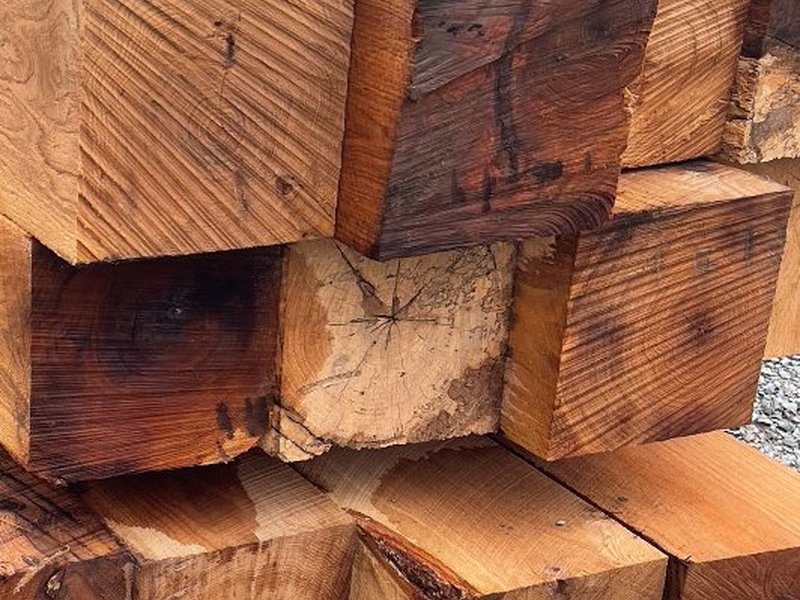
A seasoning check is the timber relieving its own tangential shrinkage stress. It runs radially, toward the pith, on one face. It does not cross the grain, so it does not interrupt the longitudinal fibers that carry bending and axial load; and because it does not pass through the section, it does not create the horizontal shear plane that a shake or split does.
The NDS timber design values in Table 4D were derived from full-size tests of green timbers that checked as they seasoned. The Fb, Fc, and E values an engineer uses already include checking as a normal condition of the material. The shear value Fv is already conservatively reduced for the possibility of splits and shakes at the grade limit.
A 12×12 boxed-heart Douglas Fir post will develop one dominant check on one face over its first two or three years. It will not develop a second one of the same size, because the first one has relieved the stress. It will not open further after the timber reaches equilibrium. It will not twist, because a No. 1 timber has no mechanism to twist. And it will carry every pound the tables say it will.
Coastal Douglas Fir: the strongest structural softwood timber available
Douglas Fir-Larch carries the highest published design values of any North American softwood timber group. The coastal (west of the Cascade crest) population is stronger, denser, and straighter-grained than interior Douglas Fir, which is why WCLIB grades it under separate rules. Values below are NDS Supplement Table 4D, Beams & Stringers, 5×5 and larger.
| Species group, No. 1 B&S | Fb (psi) | Fv (psi) | Fc parallel (psi) | E (psi) | Specific gravity |
|---|---|---|---|---|---|
| Douglas Fir-Larch | 1,350 | 170 | 925 | 1,600,000 | 0.50 |
| Hem-Fir | 1,050 | 140 | 725 | 1,300,000 | 0.43 |
| Spruce-Pine-Fir | 875 | 125 | 625 | 1,200,000 | 0.42 |
| Western Cedars | 875 | 140 | 575 | 1,000,000 | 0.36 |
Select Structural Douglas Fir-Larch B&S: Fb 1,600 psi, E 1,600,000 psi. Values are for green timbers; wet-service factors are 1.0 for most properties because timber values already assume green condition. Verify against the current NDS edition.
On stiffness alone, coastal DF is 23% stiffer than Hem-Fir and 33% stiffer than SPF at the same grade. In practice that is the difference between a 12×14 and a 12×18 on the same span, or between a heavy-timber frame that reads as slender and one that reads as bulky.
Built with No. 1 Douglas Fir, in service, no twist, no split
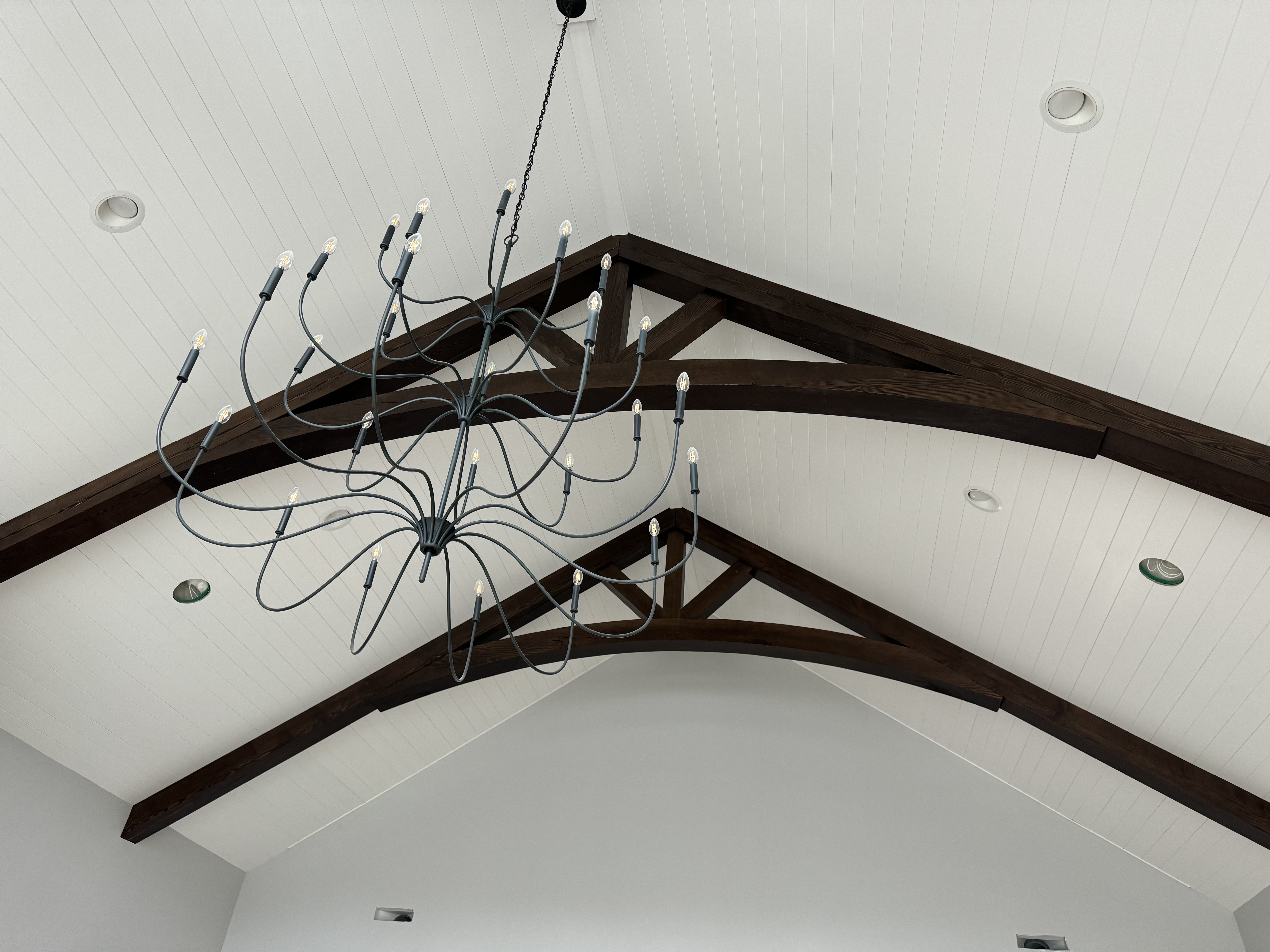
Two heavy-timber structures framed in solid-sawn No. 1 coastal Douglas Fir, both in the wet side of Western Washington — the most demanding seasoning environment the species will see in service. Both have seasoned in place. Neither has twisted, cupped, or split. Both show ordinary surface checking, which is what the wood is supposed to do.
Covered moorage, Lake Washington. Free-standing heavy-timber frame with knee-braced posts and a curved-plan purlin roof, built directly over open water with full exposure to spray, sun, and wind. Solid-sawn No. 1 Douglas Fir posts, beams, and braces on exposed steel connections. The frame is straight and true; the connections have not loosened.
Residential entry, heavy-timber truss with curved lower chord. Solid-sawn No. 1 Douglas Fir posts, rafters, arched chord, and web members, stained and exposed to weather on three sides. Curved and tapered members like these are impossible to execute in twisting stock; every joint is still tight.
Renewable, regional, and low-carbon
- Douglas Fir is grown, harvested, and replanted under the Washington Forest Practices Act on a 40–80 year rotation; every log WTC saws is replaced by a planted tree on a managed stand.
- A solid-sawn timber is the lowest-energy structural material there is: the log is cut to size and dried by the air. No kiln, no adhesives, no resin, no pressing, no petrochemical inputs. Glulam and mass timber are excellent products, but each carries the embodied energy of kiln drying, adhesive manufacture, and pressing that a solid timber does not.
- The carbon in a Douglas Fir timber stays sequestered for the life of the building, and the timber is reusable or biodegradable at end of life.
- The logs come from the North Fork Stillaguamish valley and are milled in Arlington, Washington — a regional supply chain that does not depend on Canadian tariff or export conditions.
How Washington Timber Company makes the grade hold
| Control point | WTC practice |
|---|---|
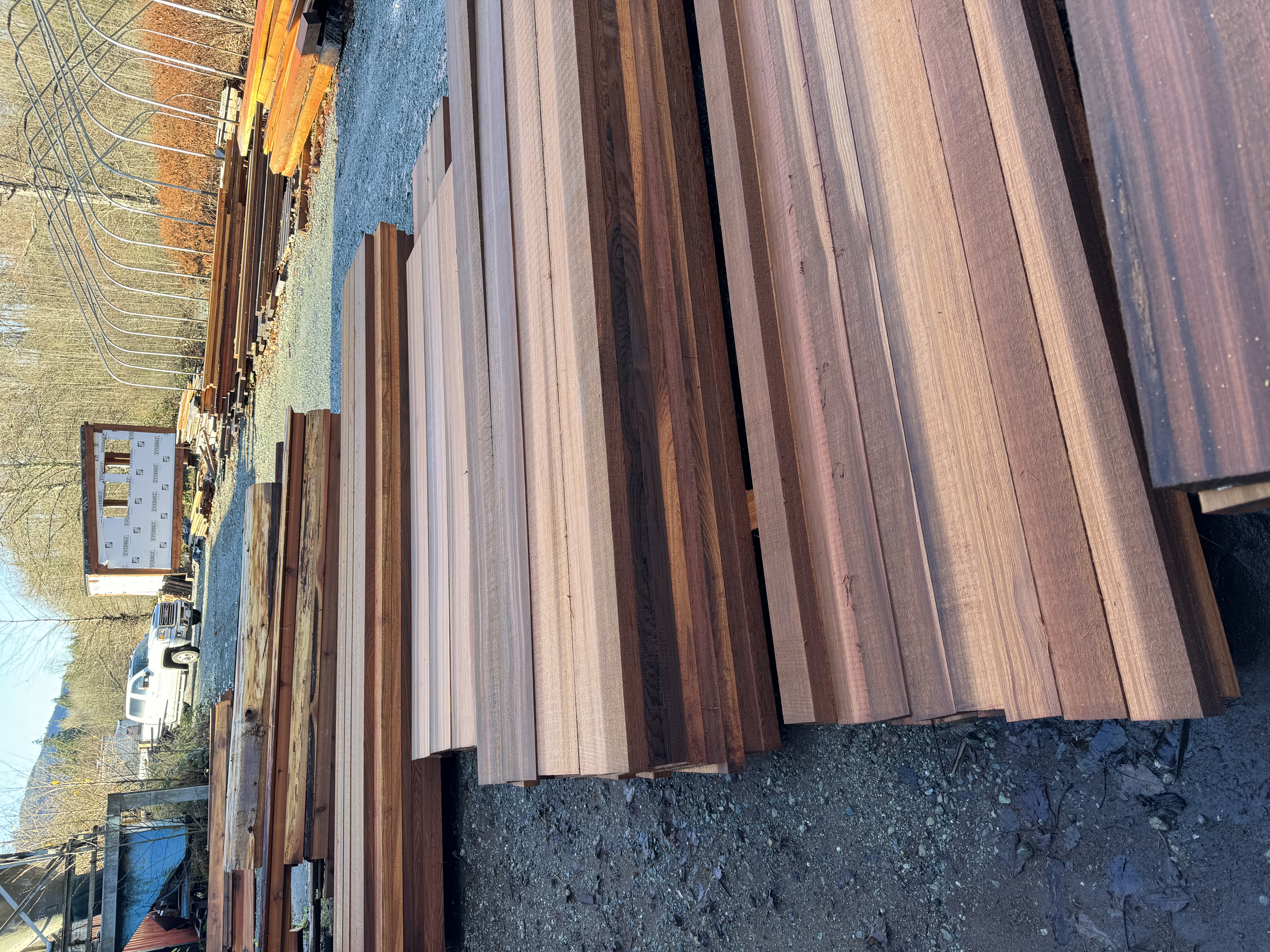
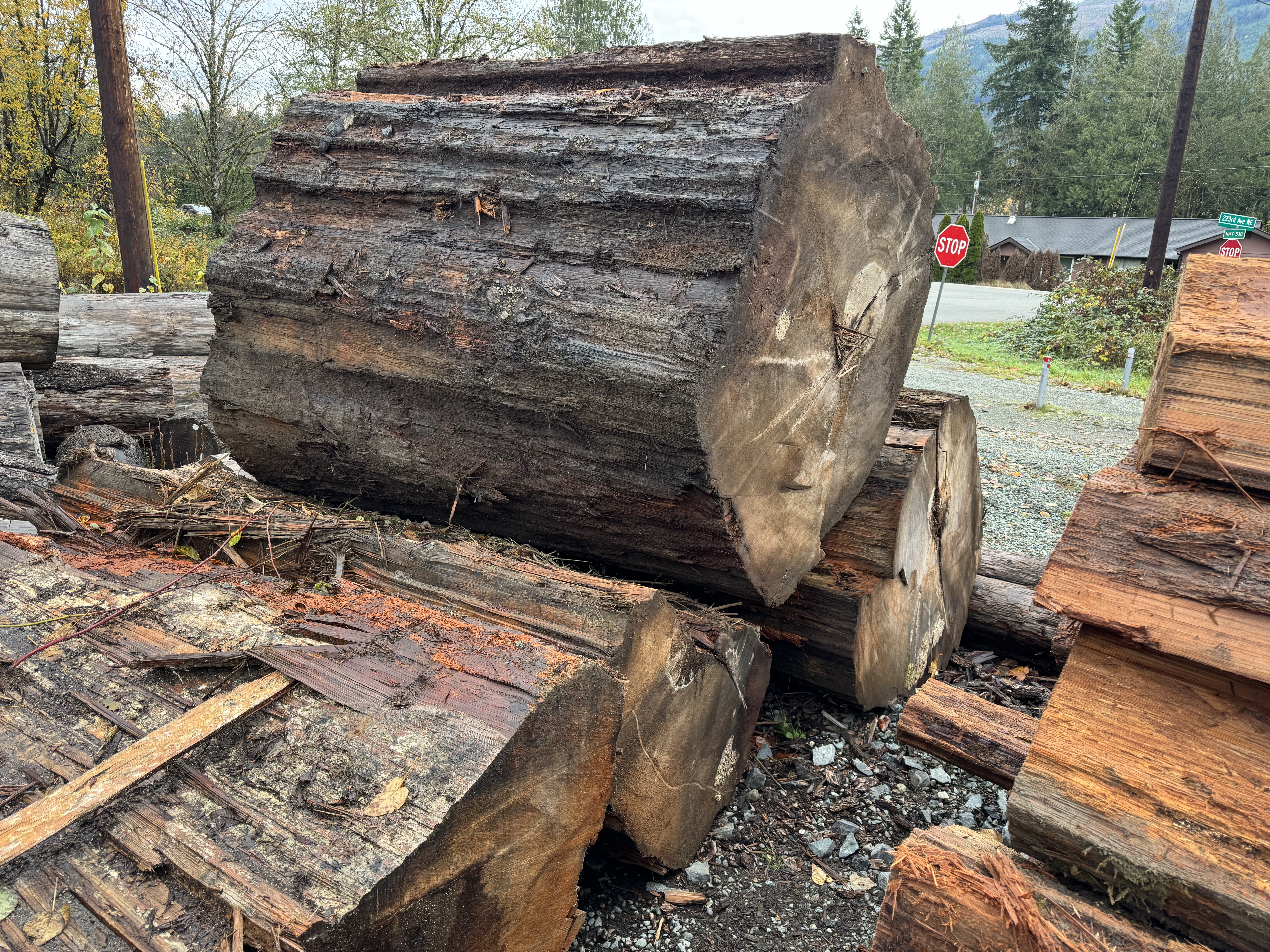
| Log selection | Large-diameter coastal Douglas Fir, chosen for straight grain and slow growth. A 12×12 comes out of a log large enough to keep the pith centered and the ring curvature gentle — the opposite of the “tight radius” problem. |
| Sawing | Boxed heart, centered, at full nominal dimension. Free of Heart Center available at 12×12 and 10×14 and smaller where appearance is critical. |
| Grading | Every structural timber graded to WCLIB / WWPA rules; No. 1 Structural is our standard, Select Structural on request. Slope of grain, shake, and knots are checked piece by piece. |
| Condition | Shipped green and seasoned in place, as the grading rules and NDS assume. See TB-01: Why Large Timbers Are Not Kiln-Dried for why oversized sections are not kiln-dried. |
| Accountability | The mill owner selects the log, watches it sawn, and answers the phone. That is the arrangement engineers have identified as the one that produced good timber in past projects. It is our only arrangement. |
Recommended specification language
Solid-sawn timber shall be Coastal Douglas Fir, No. 1 Structural or better, graded under WCLIB or WWPA rules for Beams & Stringers / Posts & Timbers, boxed heart and centered, rough sawn full nominal dimension, green (S-GRN). Free of Heart Center where noted on drawings for members 12×12 and 10×14 and smaller. Seasoning checks are permitted within grade limits and shall not be cause for rejection. Splits and shake are limited per grade.
We welcome the chance to walk any design team through the yard, put a grader’s eye on a timber with them, and show them what a 16×16 coastal log looks like before it becomes a beam. If the concern is that good solid-sawn cannot be had, the fastest way to resolve it is to hand them one.
References: AWC National Design Specification for Wood Construction, Supplement Table 4D; WCLIB Standard Grading Rules No. 17; WWPA Western Lumber Grading Rules; USDA FPL Wood Handbook (FPL-GTR-282), Chapters 4, 5, and 13; Washington Forest Practices Act, RCW 76.09.