Western Red Cedar Timber Grades: Appearance vs Structural
The grades that apply to cedar 5 inches and thicker, why Standard Beams, Posts and Timbers carries no design values, and what to put on your order.
Technical Bulletin TB-03 · Western Red Cedar posts, beams and timbers 5 inches and thicker
Almost everything written about Western Red Cedar grading is about siding and decking. Clear Heart, A and Better, Select Knotty, Architect Knotty: those are board grades, and none of them applies to a 6x8 post. Timbers are a separate grading world with a short list of grades, one of which looks reassuring on a quote and carries no engineering value at all.
If you are ordering cedar 5 inches and thicker, this is the list that matters.
The grades that apply to timbers
Under Western Red Cedar Lumber Association rules, cedar 5 inches and thicker falls into three families. Appearance grades, structural grades, and one general construction grade that sits outside both.
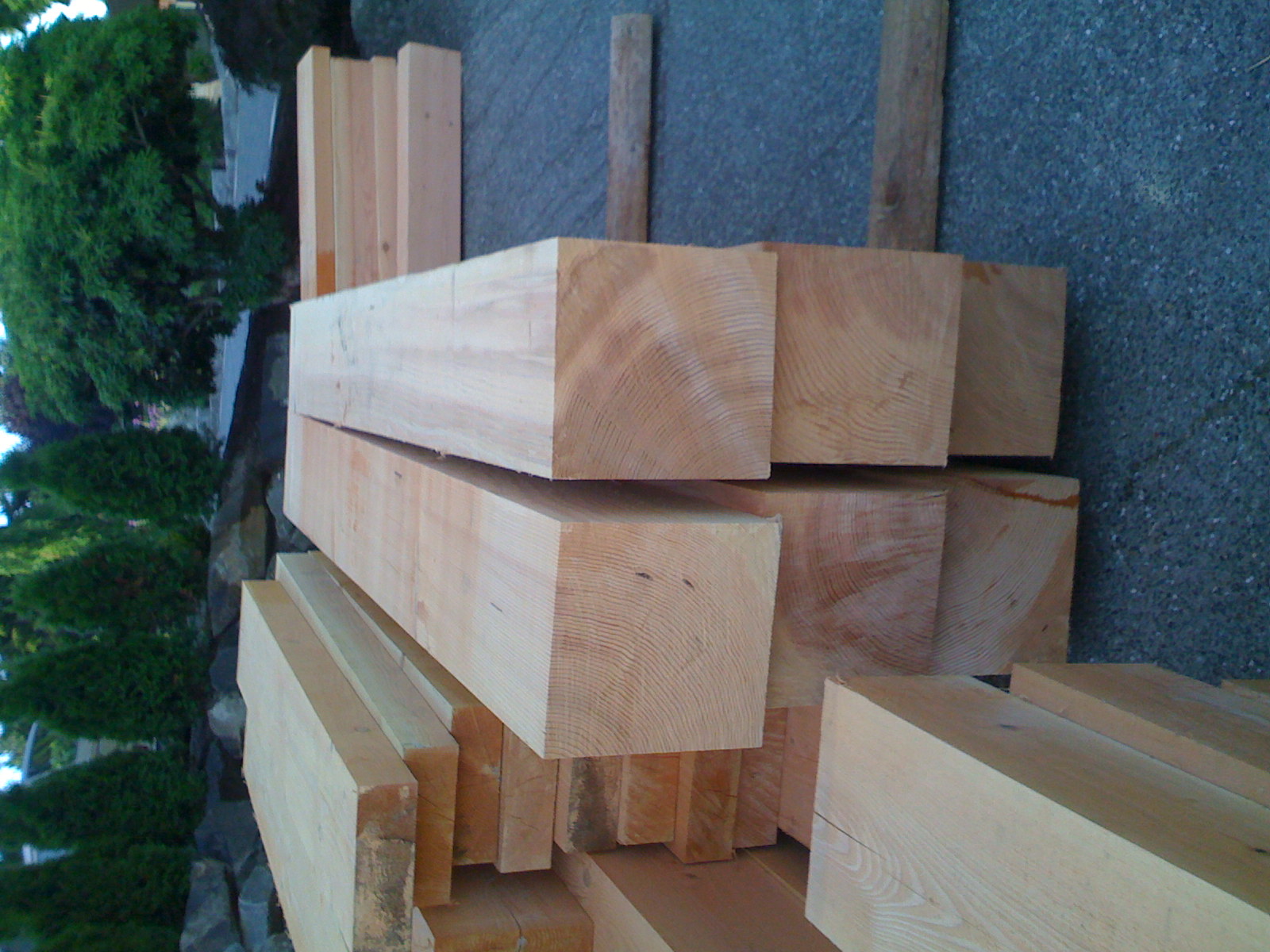
Clear grades. No. 2 and Better Clear is the top rough timber grade: sound, well manufactured, with natural characteristics that do not detract from the look. Below it, D and Better Clear covers D, C and B Clear. C and Better is the usual specification for exposed posts and beams and high quality landscape structures, and it is normally sold with a stated allowance of D grade mixed in. D Clear itself permits larger and more frequent characteristics, which most outdoor structures accept without complaint, though some pieces need trimming to produce a clear length.
Appearance Knotty. A non-structural grade intended for projects where the knots are part of the look. Wane is tightly restricted so the corners stay crisp, and the grade admits no holes. It comes rough sawn or rougher headed, in nominal 2 inch and thicker sizes. Structural grading is available on request, and that request is worth making any time the member carries load.
No. 2 and Better Structural. The grade family assessed for strength rather than appearance: Select Structural, No. 1 Structural and No. 2 Structural. Depending on the dimensions of the piece, it is graded either as Light Framing or as Structural Joists and Planks. If an engineer has specified cedar and needs published design values, this is the family that provides them. The same Select Structural and No. 1 distinction applies here as it does in Douglas Fir grading.
The grade that looks structural and is not
Standard Beams, Posts and Timbers is the one to watch. It applies to pieces 5 inches and thicker and it is intended for general construction where serviceability matters more than appearance. It is a legitimate grade, correctly named, and widely supplied.
It carries no assigned structural values.
That is the whole problem. The name contains the words beams, posts and timbers, it describes exactly the member you are buying, and nothing in the phrase signals that an engineer cannot use it. A quote reading “8x8 WRC, Standard Beams Posts and Timbers” looks like a structural order and is not one. If your drawings call out a design value, a span, or a load, that line has to say Select Structural, No. 1 Structural or No. 2 Structural instead.
This is not a trap anyone sets deliberately. It catches people because the grade name is descriptive rather than cautionary, and because cedar buyers usually arrive from the siding world where the grade names mean something entirely different.
Sizes: nominal, rough and dressed
Cedar timbers are supplied at three different relationships to their nominal size, and the quote should say which one.
| Nominal | Rough | Dressed |
|---|---|---|
| 5 in. | 4-3/4 in. | 4-1/2 in. |
| 6 in. | 5-3/4 in. | 5-1/2 in. |
| 8 in. | 7-3/4 in. | 7-1/2 in. |
| 10 in. | 9-3/4 in. | 9-1/2 in. |
| 12 in. | 11-3/4 in. | 11-1/2 in. |
| Over 12 in. | 1/4 in. under nominal | 1/2 in. under nominal |
Source: Western Red Cedar Lumber Association timber specifications.
Full sawn is the fourth option and the one that catches people out in the other direction. A full sawn 8x8 measures a true 8 inches by 8 inches, not 7-3/4 and not 7-1/2. If the joinery was laid out on full dimensions and the delivery arrives dressed, every mortise is half an inch out. Say which you want on the order, every time. The same logic applies across the full range of timber sizes.
Surface texture is specified separately: saw textured from a circular or band saw, rougher headed from roughened planer knives, or surfaced four sides. S4S is generally available up to 6x6, with anything larger made to order.
Cedar timbers ship green, and that is correct
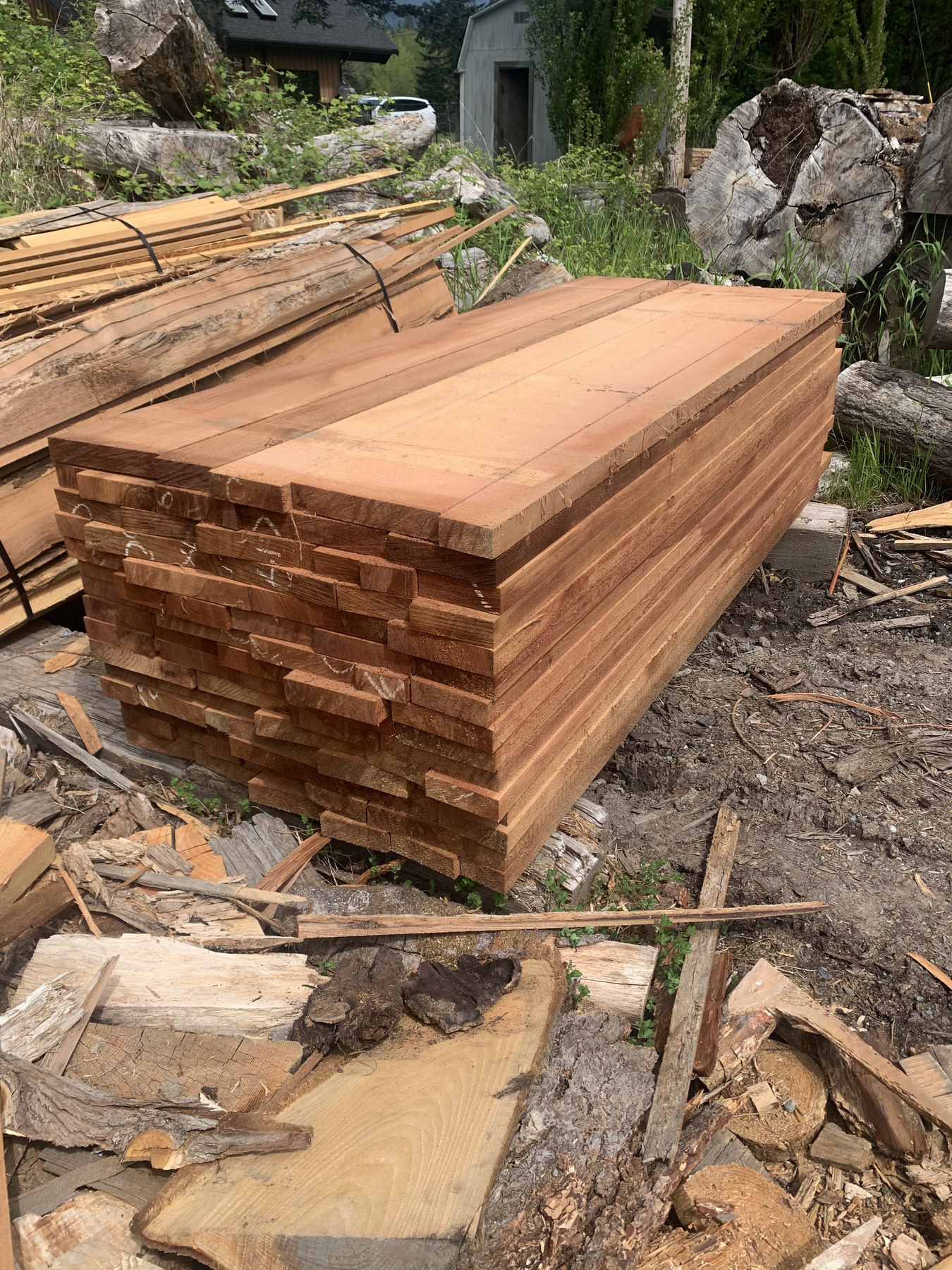
Clear grades are normally supplied green and air dried only when seasoning is specifically required. Knotty grades are the same. The exceptions are Light Framing and Structural Joists and Planks, which can also be had kiln dried.
If that sounds like a compromise, it is the same situation as every other species at this scale. Large sections are graded, sold and engineered green across the entire North American softwood industry, and the reasons are physical rather than commercial. We covered them in detail in TB-01 on why large timbers are not kiln dried. The short version: drying time rises with roughly the square of thickness, and forcing a large section to dry from the outside in produces a worse timber than letting it season in place.
Cedar handles this better than most species. Its shrinkage figures are low, about 2.4 percent radial and 5.0 percent tangential, with volumetric shrinkage around 6.8 percent. That is roughly half the movement of the softwoods it typically sits alongside, which is a large part of why cedar earns its place in exposed work.
The durability is in the heartwood
Western Red Cedar resists decay, mold and insect attack because the wood contains thujaplicins, a group of naturally occurring extractives that function as preservatives. This is why a cedar post outlasts an untreated fir one in ground contact, and why cedar is the default for exposed outdoor structures across the Pacific Northwest.
The important qualification is that these extractives are a heartwood property. The pale sapwood band at the outside of the log has very little of them and is not durable. On a board that distinction is easy to see and easy to grade around, which is why the siding world has grades like Clear Heart that guarantee a heartwood face.
On a large timber the distinction matters more and is talked about less. A big section cut from a smaller log carries proportionally more sapwood, and that sapwood is on the outside, which is the surface doing the weathering. If a cedar post is going into ground contact or into a permanently wet detail, it is worth saying so when you order so the pieces can be selected accordingly.
Cedar is also light. Specific gravity runs about 0.32, against roughly 0.42 for yellow pine, and a cubic foot weighs in the region of 23 pounds at 12 percent moisture content. It is one of the lightest commercial softwoods, which is an advantage on site and a limitation under load. Where structural capacity is the governing requirement rather than appearance or decay resistance, Douglas Fir does more work per inch of section. We compared the two directly in Douglas Fir vs Western Red Cedar.
What to put on the order
Five lines remove almost every cedar timber misunderstanding before it happens.
- Grade, by its correct name. Select Structural, No. 1 Structural, No. 2 Structural, D and Better Clear, No. 2 and Better Clear, or Appearance Knotty. If a drawing carries design values, do not accept Standard Beams, Posts and Timbers.
- Nominal, rough, dressed or full sawn. Half an inch decides whether the joinery fits.
- Surface texture. Saw textured, rougher headed, or S4S.
- Heartwood requirement, if there is one. Say it explicitly for ground contact and permanently wet details.
- Green or air dried. Green is standard at this scale. Specify air dried only if the schedule genuinely allows for it.
We mill Western Red Cedar alongside Douglas Fir at the Arlington mill, cut to the section and length the drawing calls for rather than to a stock list. If you have a drawing or a cut list, send it across and we will quote against the grade you actually need. Current rates and the surcharge structure are on the pricing page, and the lumber and milling service page covers what we can cut and to what tolerances.
Sources: Western Red Cedar Lumber Association, timber grades and specifications; WRCLA architectural specification guidance on extractives, density and dimensional stability.